The blank page can feel louder than a messy desk. You sit down with a journal, a pen, maybe a few pretty scraps, and suddenly every thought becomes too big to write. Nothing feels important enough. Nothing feels clear enough. So the page stays empty.
When that happens, do not try to write the whole story. Give the page one small doorway.

Write the color of today
Start with a color instead of a sentence. This is easier because color does not have to explain itself.
Maybe today is weak tea brown, cloudy blue, receipt-paper grey, old rose, olive green, or the yellow of a lamp that has been on too long. Write the color at the top of the page. Then add one reason.
You might write: "Today is dusty pink because everything feels tender." That is enough. A whole journal page can begin with one color and one feeling.
List three tiny things you noticed
When you have nothing to say, write what the room already gave you.
- the sound of the kettle
- a shadow on the blanket
- one flower starting to dry
- the corner of a receipt
- the way your pen feels in your hand
Tiny observations do not need to become poetry. They only need to prove that you were here, awake inside your own day.
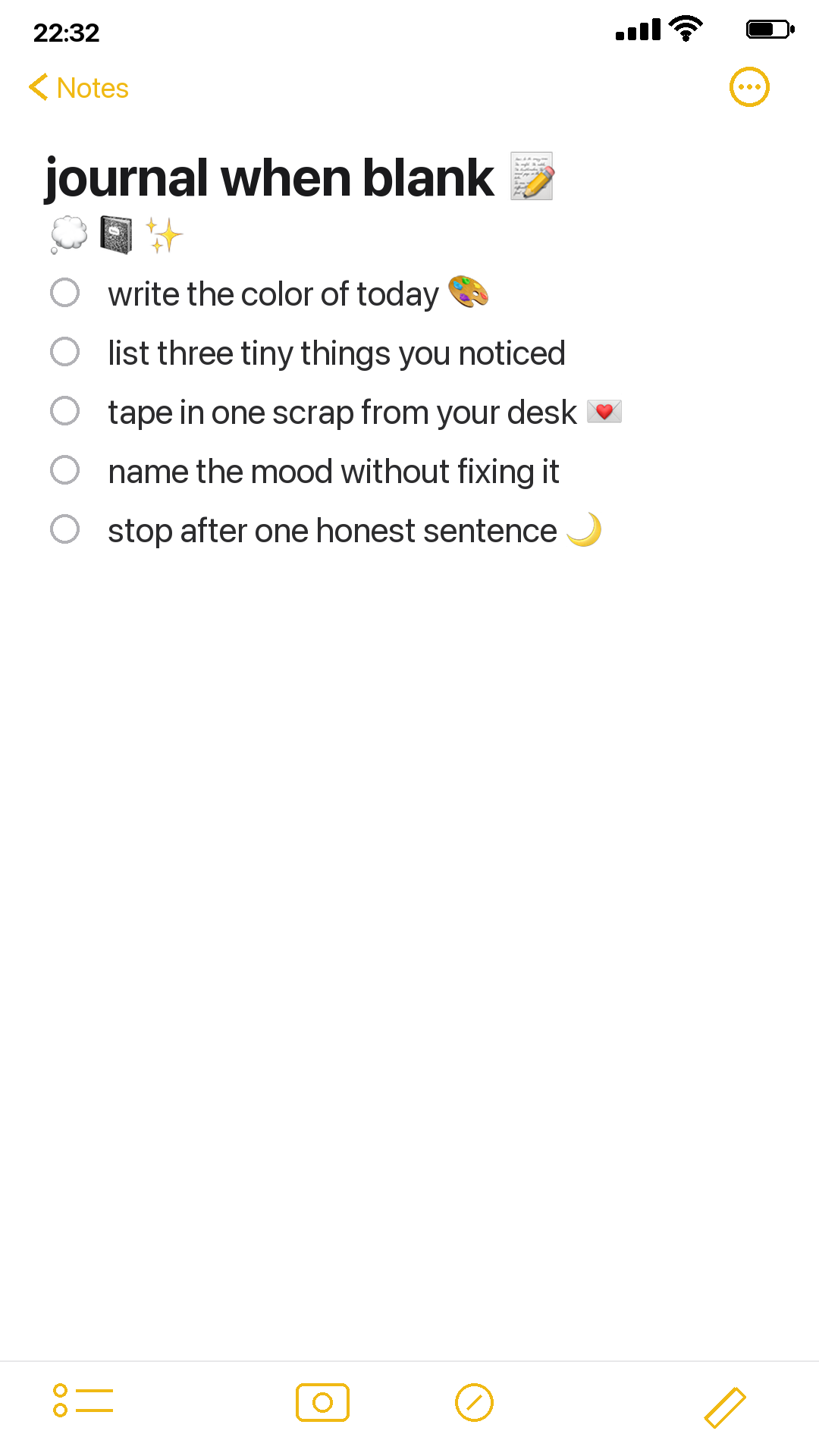
Tape in one scrap from your desk
If words are not coming, let paper speak first. Tape in one small thing: a torn envelope, a label, a wrapper, a receipt, a stamp, a list, a ribbon end, or a piece of packaging with a color you like.
Do not wait until it matches. Matching can happen later. The first job is only to give the page texture.
Once the scrap is down, write beside it:
- why you kept it
- where it came from
- what color it adds
- what it reminds you of
- what you almost threw away
The page will usually start talking after that.
Name the mood without fixing it
Some pages do not need solutions. They only need an honest label.
Try one of these:
- restless but soft
- tired in a pretty way
- wanting quiet
- almost okay
- full of small noise
- waiting for something I cannot name
You are not journaling to become more productive. You are journaling to meet yourself without demanding a performance.
Stop after one honest sentence
This is the part that makes the habit sustainable. You are allowed to stop early.
One sentence can hold the whole page:
I did not know what to say, so I saved this little piece of today.
Close the journal before the page starts asking to be impressive. Let it stay unfinished. Blank space is not failure; sometimes it is the room a small memory needed.
The next time you have nothing to say, do not search for a bigger thought. Write the color. Tape the scrap. Name the mood. One honest sentence is already a page.